
At icare, we are a people-focused business and customer is at the centre of our decision making. A key driver in enabling our customer-centred approach is HCD (human-centred design) and CX (Customer Experience – design and insights).
Through the CX team, we promote a dual culture of customer centricity and design by fostering creative thinking and a customer-centric design community across the whole business and upskilling our design practitioners and supporting them in their growth and development.

How we do this
Beyond collaboration and working together – by building a culture of shared learning so we can all leverage off each other’s expertise and experience to build deeper pools of knowledge.
Building a culture of design beyond just design practitioners – helping stakeholders across the business understand the value of design and enabling non-designers to put design thinking and HCD into practice to be closer to the customer experience, identify the right problems to solve and keep the customer at the centre of decision making, product and service delivery.
Mindset and culture shift – to enable this, we need to provide the right disciplines, tools and practices so that people right across the business are empowered to put customer-centricity and HCD into practice.
Integrated approach – there are many people within the business who have in-depth knowledge and understanding of their customer, of the technical and legislative requirements of the business, of different methodologies and business tools, such as SixSigma or culture design.
When it comes to successfully embedding a customer-centric design culture, it’s so important to do this in collaboration with what the business already knows and does rather than imposing a ‘better’ way on them. So many design tools and methods crossover into other areas – being flexible and willing to adapt frameworks, align processes and not be purist in your approach to design is critical.
Our preference is to employ a ‘Do it with me and show me how’ approach to design rather than a ‘Do it for me and talk at me’ style. We encourage all of our design practitioners to work in a consultative co-design, coaching model rather than as a solo expert owning the process model.
Leading by example – the best way to prove the value of design is to show by doing. Case studies, storytelling, taking people on the journey, running workshops that introduce HCD concepts by stealth are all useful tools in helping turn on the ‘ah ha’ lightbulb for people around what design is and how it can achieve better outcomes.
Shifting the approach – from typical HCD training to using it in practice. You can’t learn much from a half-day intro to HCD and design thinking other than ‘That seems cool’. In my experience, most non-designers walk away from such a session wondering how they would apply that to their day to day and not really being able to use their learnings.
Programs we provide
The first program I developed at icare was our in-house HCD program. This includes a modular ‘fast track’ incubator, a series of short skills-based workshops and a coaching/mentoring model.
The modular program takes components from HCD, SixSigma, Agile and Design Sprints across a double-diamond process in an incubator form. You could call it an HCD masterclass but I prefer to see it as a fast track to finding and solving the right customer problem.
We invite product and service delivery teams across the business to bring an existing business problem they’re working on into the program and run it over 4 days across two weeks. Depending on the nature of the problem to solve, we mix and match modules and activities in the program to achieve the desired outcome.
We bring in relevant SMEs and design practitioners to work with the team and build multi-disciplinary ‘squads’ to go through the process around the problem. We also recruit customers or end users to participate in discussion forums and concept testing sessions with the squads at either end of the program.
The program is designed to be highly collaborative and generative, relevant to the business context and a practical, hands-on mechanism to learn and apply design tools in real-time. And thanks to COVID, it is able to be run face to face or fully remotely online.
Very often the problem with incubator programs like this in many orgs is the ability to follow through or do anything with the outputs. Hackathons and the like often become little more than ‘innovation theatre’. To try to avoid this, we work with relevant stakeholders and SMEs upfront to frame the problem and recruit the right people in for each program and showcase the outputs to relevant senior leaders at the end, encourage teams to feed outputs into their roadmaps and to work with the CX / Service design teams embedded in their business area to follow through on the opportunities and ideas generated.
We run short skills-based workshops on topics such as storytelling, assumption mapping and root cause analysis monthly to provide continuous learning opportunities for people to keep growing their capability. These are also able to be run fully remotely online, allowing any staff from across the state to participate.
As a design team and through our broader Customer Community of Practice, we do a lot of work in coaching teams through using a design approach in practice and building champions and advocacy throughout the business. Coaching is a critical function ongoing as this allows people who have participated in the program to apply their learnings in practice.
And our HCD program is supported through our HCD Community of Practice, an alumni network to foster our champions and support their continued growth.

We’ve recently launched two new programs, aimed at expanding the CX capability practice beyond HCD, to help drive a deeper, first-hand understanding of customer and embed a truly customer-centric culture.
The first program, called Customer Essentials, is an onboarding module for new starters. The aim of the program is to align all staff on our definition of customer, who our customers are, what customer-centricity looks like at icare, how we put this into practice and what this means for people in their day to day roles.
The second program is called Customer Connections and focuses on getting our senior leadership more closely connected to our customers and their experience, as well as our frontline customer service staff. The idea with this program is to flip the service delivery model, from being top down to bottom up. The mantra is that if you’re not directly in the service of our customers, you are in service to someone who is. We want everyone being in service to our customers and our customer-facing staff, and to do this, we need to have a strong understanding of their experience and needs.
Through this program, fortnightly content drops from the CX team are provided to the executive teams across the business, including call recordings, CSAT insights, case studies and findings from customer research and audio/video recordings from customer interviews.
Executives can also participate in an onsite visitation program. They are matched with a suitable frontline team and spend a half-day onsite, sitting with the team and listening in on calls with customers or participating in other customer interactions and talking with customer-facing staff. This also gives the frontline teams the opportunity to be in front of the execs, to share their knowledge and discuss what would improve the customer and service delivery experience.
Professional development support
And finally, all of this is supported through our Customer Community of Practice (CCoP). The CCoP meets monthly and provides the opportunity for all of our CX practitioners across the business to come together, share knowledge and collaborative solve problems, align on best practice and how to drive this within their service lines. Relevant knowledge is then shared out to the business through the Microsoft Teams and Yammer COP channels for customer and HCD.
As a CX Design practice lead, I also provide individual mentoring and professional development for CX practitioners, ‘train the trainer’ programs and workshopping skills development, as well as QA and advice on uplifting CX outputs and strategic artefacts. Our team delivers programs such as monthly sit-ins and Creative Wednesdays.
Through the combination of these programs, we are covering the end-to-end process of customer-centric service delivery and delivering the tools, practices and disciplines to empower people in their day to day roles. Over the last 12 months, we have seen a marked shift in mindset, customer understanding and capability, right across the business. And exciting new opportunities are underway to ensure icare can move into the next stage of driving horizon-based innovation across the business.
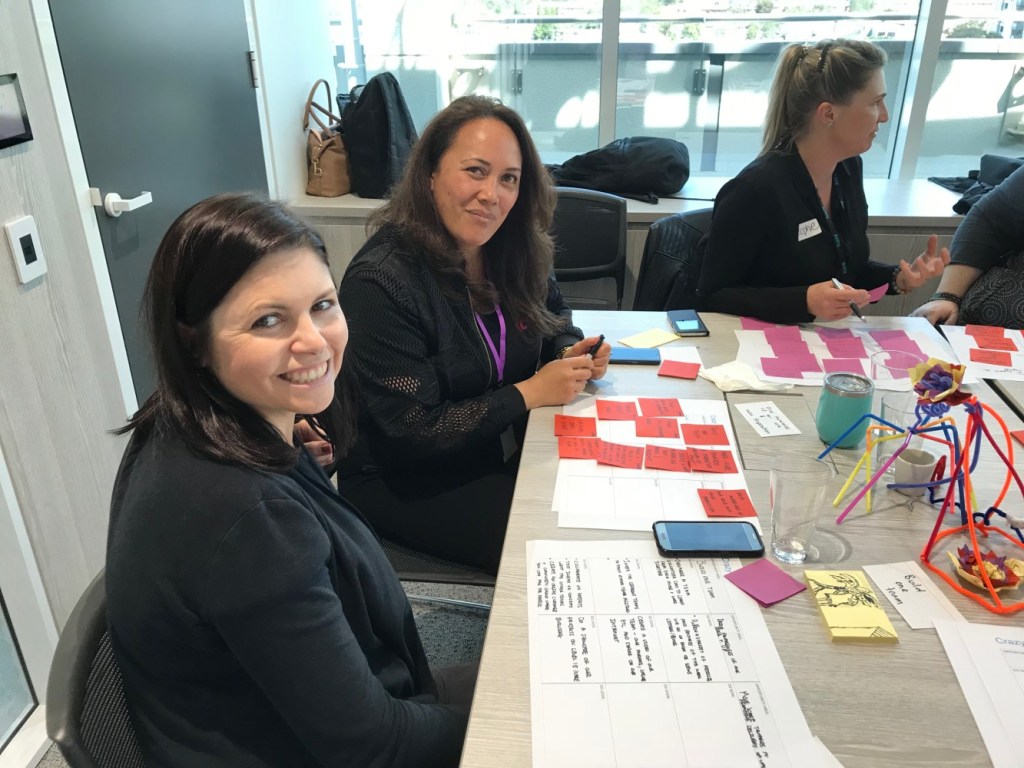
icare is a great place to work and has some of the best people I’ve ever worked with. It’s been an honour and an absolute privilege to have built an HCD program and practice, to provide training and mentoring and to run a broad range of fabulous, challenging, amazing and creative workshops. And I’ve loved seeing the growth and change as well as the increase in HCD advocates and champions across the business.
After 4 fantastic years at icare, I’ve made the decision to leave and become a full time artist. I’ve been a practicing artist for 25 years, but always as a sideline. I feel it’s time to flip that around. In standing up the HCD program and practice, it was always my intent to make myself obsolete within 5 years. I’m excited by this opportunity – and by the opportunity this opens up for somebody to step into my role and take the organization to the next level. I feel we’ve built a very solid foundation for HCD at icare and can’t wait to see how it evolves from here.
 Bea Pierce Design
Leave a comment